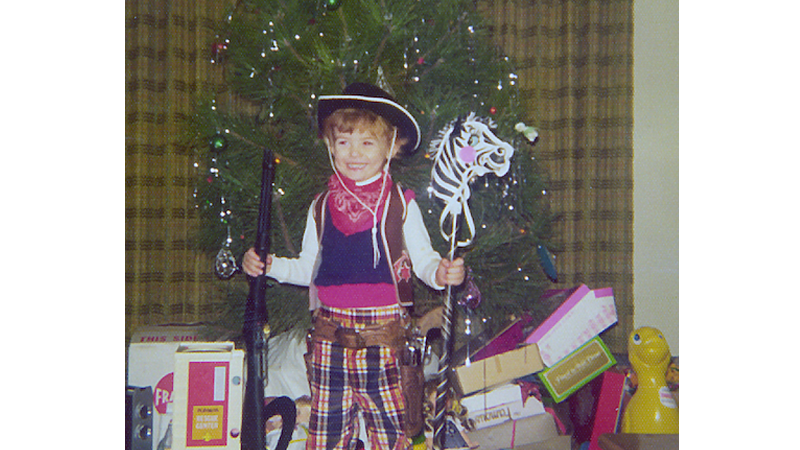
When I was three, my parents bought our first house. It was the most 1973 you could pack under one roof: a chocolate-brown split-level with wall-to-wall shag carpet, avocado green appliances, a harvest gold toilet and tub, and a rec-room with a hi-fi console stereo and rough-hewn wood paneling. Dy-no-mite!
However the house had a major flaw. No, it wasn’t built on an Indian burial ground. There was no fireplace.
Why would a 3-year-old Marketing Guy get so hung up on the absence of a fireplace?
Answer: no chimney.
What, do I have to spell everything out for you? If you don’t have a chimney, how in the H-E-double candy canes can Santa come?
When I posed this question to my dad, he was quick on the draw.
“That’s ok. We’ll just leave the front door unlocked. He’ll get in that way.”
The front door? Are you serious? Where’s the magic in that?
I was not convinced. That’s not how Santa rolls. He always comes down the chimney.
It was certainly logical that he would use the door – but it went against my internal narrative.
No book I ever read said anything about Santa using the front door. That just sounded so… so… normal.
Santa uses the chimney, dammit.
I quickly realized that three-year-olds have little to no recourse in matters such as these, so I could only pray that my dad was right. My Christmas fate was in his hands. An entire year’s worth of stellar behavior and good deeds was riding on his promise. Would Santa use the door? Could Santa use the door?
Before going to bed Christmas Eve, I stood at the top of the steps and watched with my own eyes as Dad double-checked that the door wasn’t locked.
Suffice to say I did not sleep well that night.
I woke up Christmas morning afraid to get out of bed for fear my worst nightmare would be realized: a Christmas tree with nary a gift neath the boughs in a cold, lonely rec-room bereft of even the slightest holiday cheer.
After what seemed like hours of agonizing contemplation, I mustered enough courage to venture down the hallway.
Halfway toward the rec-room, I began to hear Bing Crosby and David Bowie singing from the console hi-fi, “Come they told me, pa-rum-pa-pum-pum…”
At that instant, all my fears evaporated and I ran full sprint into a magical rec-room bursting with boxes and bows and tinsel and Christmas cheer. Santa did use the door! He didn’t need a chimney after all.
All was right in the world once again. My anxiety was soothed. Christmas joy restored.
So what does all this have to do with community college marketing?
You don’t need proof; you need belief.
Three-year-olds aren’t the only ones who hold onto preconceptions stronger than they can embrace logic.
Any one of us worth our salt can mindlessly spew data points, statistics, and case studies about how community colleges are the bee’s knees.
But in the art of persuasion, facts rarely matter. It’s all about the story.
For many potential students, community colleges are like my house: they don’t look quite right.
There’s something missing.
It might be that we’re not a “real college.” Or maybe it’s that program they swear we don’t have.
Sometimes it’s that one story the neighbor heard about that bad instructor who taught that one class.
You know the one.
At the core, it’s often a deep-seated self-doubt or fear of the unknown:
Will they like it? Can they do it?
Like my dad, all we can do is answer their questions and calm their fears.
We have to help them work through their own story and reassure them that everything will be okay.
Eventually, some of these students get courage enough to trust us and embark on their journey.
As they venture down our hallways, they start to see the same thing I did.
It may not be boxes and bows and David Bowie, but it’s no less magical.
They get to know us, take ownership of their education, cozy up to their new world.
How they used to feel melts away.
Soon, they can’t believe what kept them from coming in the first place.
It was a silly fear that they got all worked up about for no reason.
The answer is only obvious once you find it. Everybody knows that.
Just ask me.
Of course Santa uses the door. I never doubted it for a minute.
Apply Some Holiday Marketing Magic to Bring Good Tidings All Year Long
Belief doesn’t happen in a single moment — it builds with every experience they unwrap.
1. Wrap your facts in comfort and joy.
Start with empathy, not logistics.
A warm welcome from a real student, a nudge of encouragement, or a message that says “you belong here” goes a lot further than a bullet list of class schedules.
Save the specs for later — start with the story.
2. Cast them in their own Hallmark movie.
No, not the over-the-top “big city girl rediscovers small-town charm” script — the one where they finally see themselves succeeding in school, landing a job they love, or making their kid proud.
Paint that scene. Show them how their story could unfold with you as the setting.
3. Be their North Star.
Your emails, ads, postcards, and posters might feel like small stuff — but to the right student at the right time, they’re like tiny little twinkle lights on your college’s tree.
Keep them lit. Keep them coming. Keep reminding students that they’re not alone.
(first published on the NCMPR blog, December, 2013. Updated 2025)
Want more great stuff like this?
Sign up to get the latest tips, tricks, stories and more. Scroll down to get started.


 Jeff Ebbing, Higher Ed Marketing Guy