
Weekly team meetings are the swamp of sadness where good intentions go to die.
Show up, chat for ten minutes, start eventually. Go around the table, some folks drone on, others give a 90-second update. You hold court while scribbling on the whiteboard or mousing around on the big screen. Side conversations pop up. The clock runs long. You walk out with a page of notes, tackle a few items right away, and the rest resurface at next week’s meeting like undead tasks that refuse to stay buried.
There’s nothing wrong with this. At least you’re communicating. But it’s not efficient. It doesn’t surface what’s really going on in people’s heads. It doesn’t leverage the collective smarts of the group. And it sure doesn’t respect everyone’s insanely precious time.
If only there was a way that a manager could get a pulse on how each person is doing, understand their most pressing issues, workshop their most urgent challenge, celebrate their wins, and commit to their biggest takeaway for the rest of the week.
And do it all in one hour or less.
There is.
Introducing Jeff’s Amazing Team Meeting Format For Super-Duper Success & Stuff
(or as I lovingly call it, JATMFFSDSS — hey, I’m working on it.)
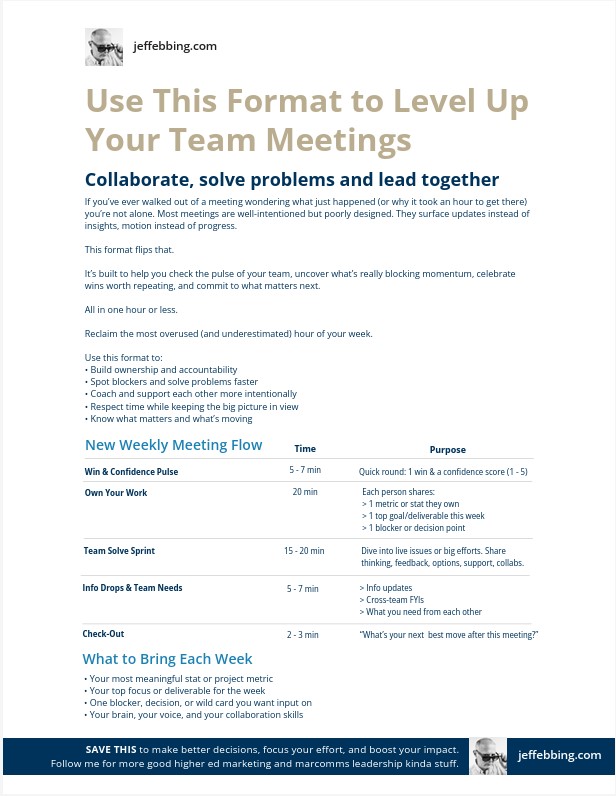
Here’s how it works:
1. Quick Win & Confidence Pulse
Everybody needs a chance toot their own horn, so start things off with a baby boost of endorphins. Let them share a win they’ve had since last meeting.
De-bug that nagging tiny piece of web code? WIN!
Get a stellar stat on that last email campaign? WIN!
A win is a win is a win. Celebrate it.
Then, take the team’s temperature. How is everybody feeling? Energized? Overwhelmed? Let them score it. Give it a 1–5. It’s an instant morale check.
All high scores? Lean into the collective high and stretch them.
Low scores? Ease the throttle.
Mixed? Ask questions.
And don’t worry. If you provide your team a safe space to share how they’re feeling, they will tell you. And you’ll be a better leader for asking.
2. Own Your Work
Give each person the opportunity (and responsibility) to own their space. Each person shares:
- ONE metric they own and how it’s going
- Their top deliverable goal this week
- One blocker they can’t get past
Pay attention and you’ll start to see trends. The blockers will fall into one of these 4 P’s:
Is it Personal? Process? Priorities? Political?
Identifying and removing these blockers is some of the most important work you’ll do all week.
3. Team Solve Sprint
Workshop those blockers to zero in on problems and identify solutions. Resist the urge to jump in and solve it.
Steer the convo when needed and let the team wrestle through the challenge. You’ll see growth as people around the table start breaking down tactical problems into manageable chunks and considering upstream and downstream impacts.
Your little marketing babies are growing up! It’s a beautiful thing when it happens.
4. Info Drops & Team Needs
Give everybody a chance to provide heads-up notices about what’s going on and what they need from each other.
Easy in. Easy out.
5. Check-Out
Go around the horn one last time for everyone to verbalize the most important thing they need to accomplish. That tiny bit of social accountability may be just what they need to tackle it.
Wanna Roll It Out?
Give everybody a heads-up that the change is coming. Then the week prior, share the new format and go over it.
Remind them to bring their brain, their voice, and their collaboration skills.
And this goes without saying but… You. Absolutely. Have. To. Model. The. Behavior. You. Want. To. See.
If you’re like I used to be and you just wing it, this will be an adjustment for you, too.
Commit to this format for one month and I promise you’ll see the difference, nay, you’ll FEEL the difference. Your team will, too.
Pro Tip:
If you REALLY want to level up, implement this format after you’ve facilitated a SMART goal-setting session.
Not only will everyone be empowered to tackle their work, they’ll be able to draw a straight line between the goals they set and their day-to-day work. It’s the ultimate turbo boost.
Final Takeaway
You don’t level up your team by adding more meetings.
You level up by making the ones you already have work harder for you and your people.
Reset the format, sustain the habit, and you’ll reclaim the most overused (and underestimated) hour of your week.
Author’s Note
This is part of the Marketing Survival Series
In case you missed them:
- Part 1: See It — The Impact/Effort Matrix
- Part 2: Kick the Crap Work to the Curb
- Part 3: How to Stop Wasting the Most Important Hour of Your Week
- Part 4: Why Working 12 Hour Days Makes Your To Do List Longer
- Part 5: Sustain It: Protecting the Work That Matters


 Jeff Ebbing, Higher Ed Marketing Guy