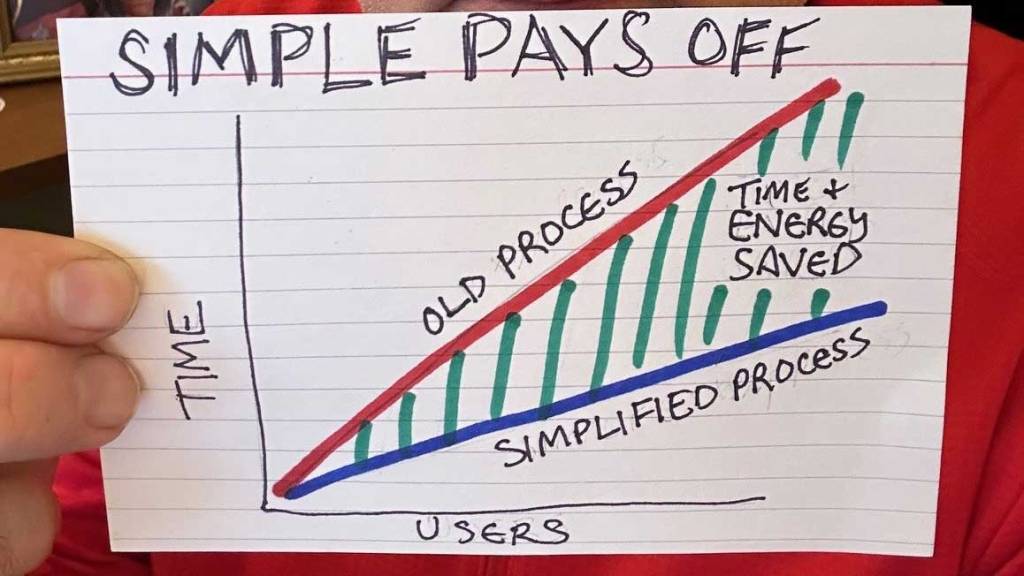
A case for doing inefficient work in the name of efficiency.
If your desk is like mine, you’ve got well over a dozen projects in various states of development at any given time. Finding time to move each one forward and get them back in someone else’s court is hard enough. Indulging in a deep dive to reimagine a single project or process flies in the face of your efforts to become efficient and streamlined.
However, the time and effort you save by punting on the complex work is more costly than you might imagine.
There are times when our struggle to work efficiently is counterproductive. Sometimes, doing the inefficient thing is the best move. When the urgent always wins, the important work never gets done.
If you’re familiar with my Impact/Effort Matrix, I’m talking about projects that land in the Big Bets quadrant: high effort/high impact.
Here’s a few examples of what I mean:
Think about your last website redesign project. Remember when you put all that time and effort into cleaning up the navigation, simplifying the copy, and laboring over that little three-word CTA you put in that one button? You know the one.
Was it really worth it?
Absolutely.
The countless hours that went into that project are now quietly paying dividends with every visitor. Thanks to your hard work, the person who just visited your financial aid application FAQ page found answers 10 minutes faster and with half the frustration than someone who visited your old site. And tomorrow’s visitor? They reap the same reward. So does the next visitor, and the next, and the next. Ten minutes times 1,000 visitors to your financial aid FAQ page equals 10,000 minutes of time saved. It’s surprising how fast all that hard work you put into the site starts compounding interest in reduced friction and frustration.
That’s the multiplier effect of making complex things simple.
And that clarity matters. How many anxious prospects landed on your old page and got lost and gave up? When our website confuses visitors out of applying, we’ve failed our mission. Accessibility isn’t just about compliance, it’s about confidence. We owe it to our students to make the path easy to follow.
Sure, we don’t rebuild websites every day, so let’s look at something smaller but just as powerful.
Take your style guide. Too many treat it like an academic exercise, something pretty to show off or relegate to telling people how to not use our logo. If that’s you, you’re missing out on the invaluable tool it is. The hard work we put into it today to think through applications, scenarios, and design challenges, we create solutions today that solve tomorrow’s problems. When a project calls for something specific, we already have the answer. It’s like a playbook a coach uses during a game. You already spent time developing and practicing it. When the situation arises, everybody already knows what to do and can focus their energy on the task.
Tackling this kind of productive inefficiency today is a weight lifted, a gift we give to our future selves, our teams, and our students. We put in the hard work now to make everything else simpler later.
You may not be a master UX developer, designer, or copywriter, but that doesn’t mean you can’t level up your simplicity game. Here’s a framework for breaking down complex things into simpler components and figuring out the hard parts.
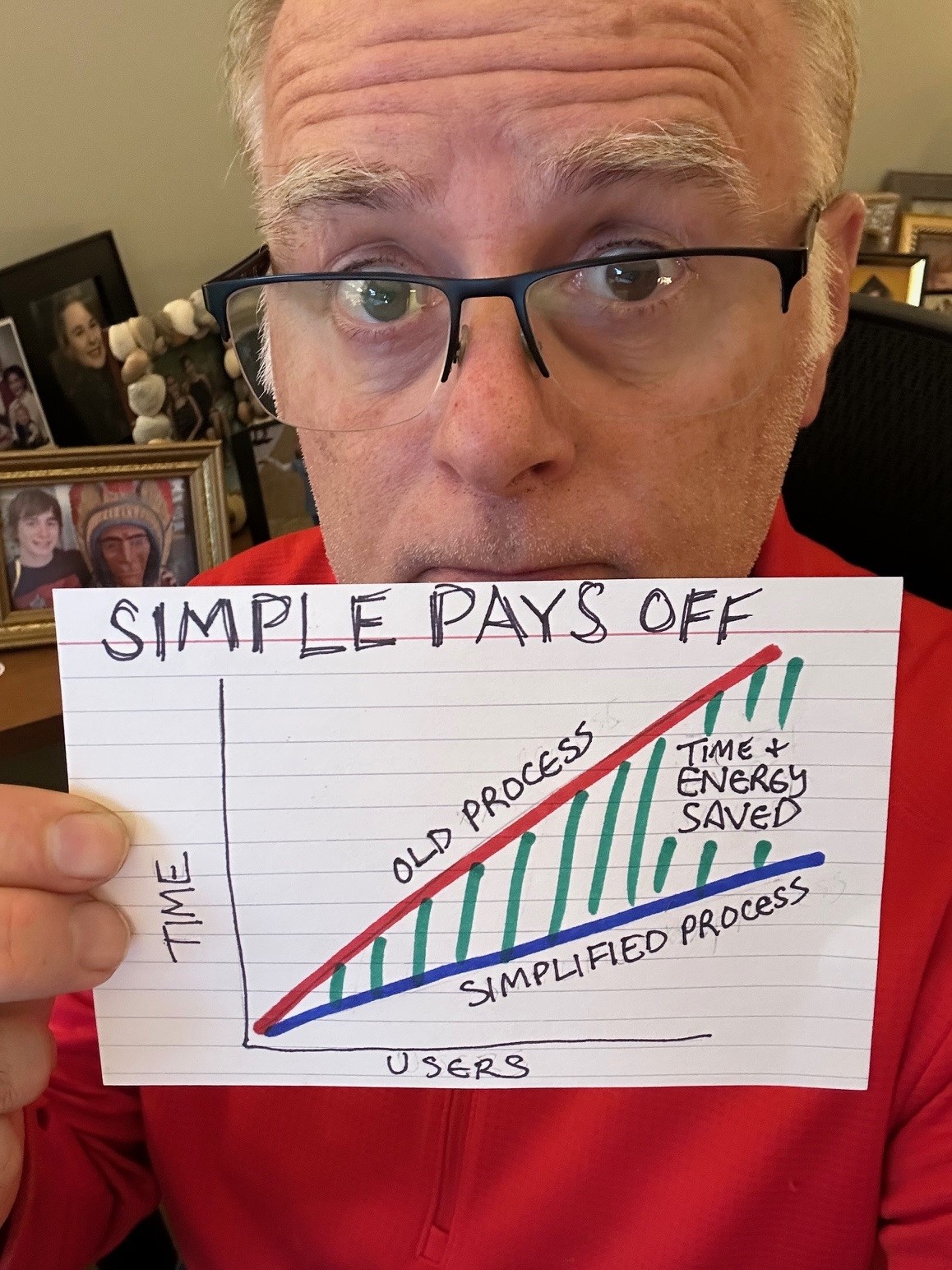
Jeff’s Tips to Make Simple Less Hard
1. Make the problem the teacher.
The next time you come across a project that’s a candidate for simplification, commit to doing the work. Don’t skip it. Put in the work to break the process into individual steps and remove friction wherever you can. It will take extra time, but you know it’ll be done right. Plus, you’ll get more comfortable with the process and build confidence for the next challenge. Every project becomes a training ground for the next one.
2. Make your style guide count.
Don’t just have a style guide. Make it matter. Flesh out your audience personas, develop clear copywriting voice and tone guidelines, wrestle out the biases and blind spots, and include real examples of what not to do. A strong, living guide eliminates debate, protects your brand, and gives your team a shared playbook to work from every time.
3. Incorporate Continuous Feedback and Iterative Improvement.
Simplicity is never one-and-done. You don’t need a fancy usability study to get valuable feedback. Even a few informal conversations with end users can reveal friction points worth fixing and keep your work grounded in real experience. Bring challenges to your team and listen to different perspectives to uncover insights you hadn’t considered. Each round of feedback and refinement makes your systems, templates, and content stronger.
4. Build with Empathy.
Keep the end users in mind. Make their experience as frictionless and intuitive as possible. Understanding is critical. Don’t expect them to do the hard work of figuring out something you could (or should) have made easier. Minimize their cognitive load so they can move smoothly through the process, whether it’s a flyer, an email, a website, and yes, even a logo. For many people, clarity is confidence, and confidence is what keeps them moving forward.
5. Protect your future self.
You know what your job is like, so build systems, processes, and tools you’ll actually use. Templates and guidelines aren’t busywork, they’re your guardrails. The hard decisions you make now will mean faster turnarounds, fewer errors, and higher-quality results later. Simplify today so your future self can focus on creative execution instead of cleanup and rework.
See It. Shift It. Sustain It.
What we’re really doing here is building better systems. Each small fix, each guideline, each simplified process reduces friction across everything else we touch. That’s the quiet power of systems thinking. It scales the impact of every good decision we make.
Making things simple doesn’t happen by accident.
First, see it: spot the complexity that’s slowing you down.
Then shift it: put in the work to make it clear, intuitive, and repeatable.
Finally, sustain it: build those habits into your process so the benefits compound over time.
Simple is hard. It takes time, patience, and focus. But the effort you put in now keeps paying off long after the project is done.


 Jeff Ebbing, Higher Ed Marketing Guy