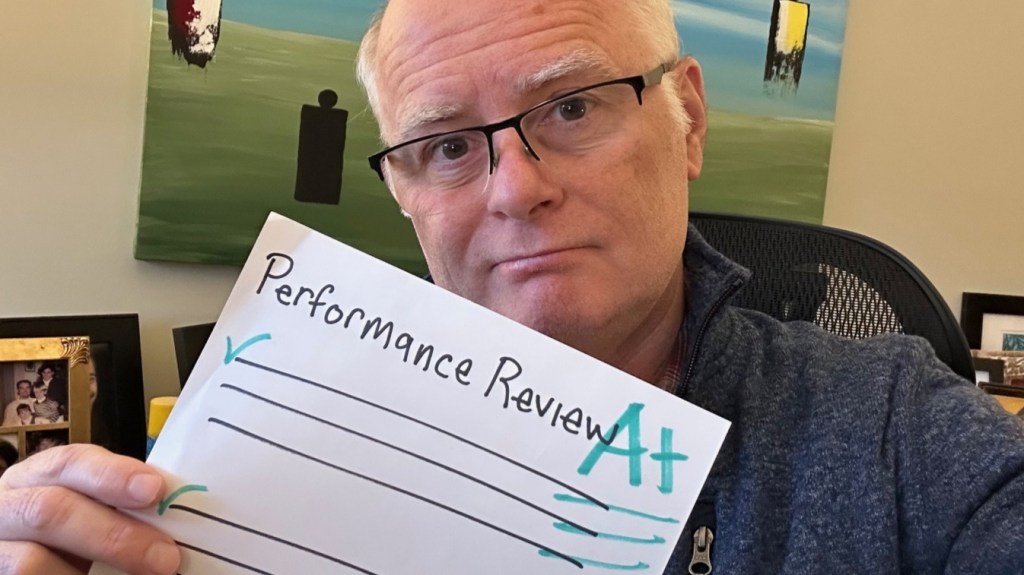
The danger of coasting on praise, and why self-driven development matters.
There you are. Sitting across from your boss during your annual performance review. Maybe you’re basking in praise. Maybe you’re under the microscope.
In either case, there’s a hidden challenge and a bigger opportunity.
In most workplaces, especially higher ed, we use these meetings to set the course for the future. However, they primarily look backward. They are literally called “performance reviews.” They measure what we’ve done rather than what we’re capable of next. And when you’re trying to grow and set direction, this can feel like driving forward while only looking in the rearview mirror. In a system that often overlooks initiative or development and uses backward-looking instruments as a guide, it’s easy to slip into complacency or burnout.
That is exactly what happened to me.
There were seasons in my career where I was crushing every project, getting gold stars from my boss, and being told everything looked great. And buried in those seasons were initiatives when I missed the mark or flat out dropped the ball, but the evaluation tool rarely reflected those shortcomings or addressed fixes for them in any meaningful way.
The end result was usually the same: a positive, feel-good review that lacked the substance I needed to guide me for the year ahead.
After years of rinse and repeat, I stopped growing. At least, not at the pace I wanted. No forward-looking plan. No built-in accountability partner. I became a modern-day Rip Van Winkle. I flatlined my growth for nearly a decade before waking up and realizing the world had moved on.
Earlier in my career, I had the opposite experience. I worked for a leader who didn’t understand staff development and lived firmly in the “what have you done for me lately?” camp. Growth in that environment wasn’t healthy either. It mostly consisted of reactionary sprints to chase trendy rainbows I was never going to reach.
When your boss doesn’t understand your job or how to grow people, it’s easy to be under-challenged or over-judged. Either way, your growth suffers. And it gets harder to show up with fresh ideas or energy.
So what do you do when you truly want to level up but the review process stunts your growth?
Whether your boss is overly pleased or perpetually demanding, the key is the same. You take ownership of your own professional growth.
Jeff’s tips to flip the script.
1. Cultivate a Growth Mindset
Regardless of how your performance is rated, stay curious. Embrace the belief that you can always learn, stretch, and improve. See challenges as invitations, not obstacles.
In higher ed, where professional development is often the first thing kicked to the curb when budgets get tight, this mindset matters even more. It helps you seek new skills, stay nimble, and better weather changes in your institution or team.
Treat your review less like a scorecard and more like a map. Use it to figure out where you are now. Then decide where to go next.
2. Set SMART Personal Goals
A great review should never mean you stop pushing yourself. Use it as a springboard to set goals that matter, not just ones that match your job description.
Use the SMART framework:
• Specific: Make it clear and actionable.
• Measurable: Know when it is done, or at least moving.
• Achievable: Push yourself, but be realistic.
• Relevant: Align it with where you want to go.
• Time-bound: Add a deadline to keep it real.
If your institution is not investing in your development, invest in yourself. You don’t need a title change, or even a budget, to start growing.
If there is one piece of advice to take from this article, it’s this: set SMART goals. Everything else builds on that.
3. Embrace Constructive Self-Assessment
Don’t wait for feedback.
Look at your own habits, skills, and gaps. What is something you have avoided learning? What part of your work drains you? What energizes you?
Be brutally honest with yourself. Deep down, you know your weaknesses, Own them.
Keep a running list of what you want to improve. Turn it into a personal growth plan or a quarterly check-in. You cannot steer growth if you do not know where you are starting.
4. Identify Blinds Spots
Even the best reviews only happen once or twice a year. That’s not enough for real growth.
Ask for feedback from people who see you in action. Colleagues, collaborators, campus partners. And don’t forget your own team, especially if you are in a leadership role.
Last year, I asked for permission to conduct a formal 360 and personally invited each participant. HR summarized the results to preserve anonymity. It confirmed my strengths and my known weaknesses, and surfaced blind spots. It gave me a baseline I could actually use.
It does not have to be a formal 360. You can even get useful feedback from a hallway conversation or a quick post-project debrief.
5. Align With Institutional Goals
Performance doesn’t exist in a vacuum.
Understand where your college is headed and how your role supports that mission. It helps your boss see your value. When you speak the language of institutional impact and connect your goals to theirs, your contributions are harder to overlook or minimize.
6. Manage Expectations
If your boss doesn’t understand your job, or expects too much with too little, advocate for realistic priorities.
Ask for clarity on what success actually looks like. Show them the time, effort, and resources required. Use data to reset expectations.
That is not complaining. It’s managing up. And it is a leadership skill that will serve you for the rest of your career.
7. Build a Support Network
Surround yourself with people who challenge you, support you, and help you grow.
Join professional groups. Find a mentor. Talk to peers outside your institution. They help you stay sharp, stay sane, and spot opportunities you can’t always see. They also help you name what you’re struggling with.
Sometimes the best feedback comes from someone who is not your boss.
See it. Shift it. Sustain it.
This isn’t a one-and-done quick take. It’s a future-proof plan to level up your career.
• See where you are. Take an honest look at what is working and what is not.
• Shift your strategy. Set goals. Build skills. Change direction when needed.
• Sustain your progress. Reflect, adjust, and keep momentum over time.
When you own this process, performance reviews no longer define your growth.
You do.


 Jeff Ebbing, Higher Ed Marketing Guy