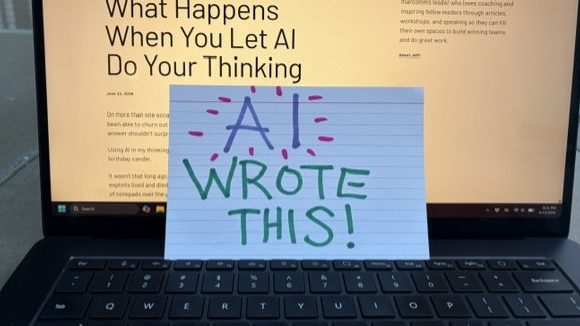
On more than one occasion over the past year and a half, people have asked me how I’ve been able to churn out so much content and think pieces and maintain my day job. The answer shouldn’t surprise you: AI.
Using AI in my thinking and content work has been like pouring rocket fuel on a birthday candle.
It wasn’t that long ago that I was 100% old school. For over two decades, my creative exploits lived and died between the blue pinstripe rules of yellow legal pads. I filled dozens of notepads over the years.
Now with AI, my iteration loop for developing ideas spins crazy-fast. I can workshop a half-baked idea into a legit durable framework in 30 minutes. The volume, depth, and quality of my thinking has grown exponentially.
But with great power, comes great responsibility.
One time I was working on a piece where I was a little bit out of my element and I really wanted to have an opinion and speak with authority. So I gave AI the keys. The draft was good. The logic was sound. And it was better organized and thought-out than what I could have written.
Except it wasn’t me.
I had to wrestle with it to insert my voice and make it my own. The more I tried, the worse it got. It ended up taking me hours write something that truly was my opinion in my voice. And by then, the argument was nowhere as tight… and it still didn’t quite feel like me.
In an effort to catapult myself from novice to expert, I had farmed out too much of my thinking. I didn’t process it with my own synapses, Instead, it was generated by a CPU in some server farm God knows where. The chasm of understanding was too wide for me to cross to craft points that were legitimately mine.
I took one too many shortcuts and ended up getting lost. Like, really lost.
Sure, I could have Jeff’d it up here and there but I would have felt fake. Anyone who pushed back on the piece would expose me as a poser. And rightfully so.
Not quite the look I was going for.
As I flew through the prompts constructing the narrative, AI had removed the friction. But what I had failed to understand was that friction is where the thinking happens.
I felt like Ulysses. AI was my modern day a siren beckoning me onto the rocks of credibility debt. And in a world flooded with AI slop, pushing work that doesn’t carry your judgment isn’t authority. It’s noise.
But that doesn’t mean I stopped using AI.
Shunning AI for sake of purity is a fool’s errand, too.
Prehistoric man didn’t ignore the wheel after it was invented. And subsequent generations of creatives happily made friends with the printing press and word processor when they came along. They adopted the tech, reassigned their thinking, and created something worth sharing. Productivity and learning skyrocketed.
With my task list today, the old legal pad analog workflow just isn’t in the cards. I don’t have the luxury to wall myself off from the world to create. Most directors I know can’t either. We’re all running lean teams, managing up, producing content, and trying to think strategically inside institutions that rely on us to get the next email out the door.
Shit gotta get done.
So if going all-in with AI isn’t the answer and ignoring the tech isn’t either, what’s a marketer to do?
It comes down to agency: where are you keeping it, and where are you giving it away?
Farm out too much of your thinking and you get over the tips of your skis and you’ll struggle to stick the landing. And going it alone foregoes the mental sparring reps that bulk up your thinking and analysis.
There’s the third lane: Use the time AI gives back to go further than you could before. Explore angles you never had the capacity to reach. Take the risks that get you to the edges of your thinking instead of stopping at competent and forgettable.
AI didn’t give me my time back. It let me go further.
Here’s what deliberate AI use looks like in practice.
Ask yourself three questions when deciding where to keep agency and where to hand off load:
1. Will I need to teach this or defend it? If yes, do your own thinking and use AI to pressure-test it. If you can’t hold a conversation about the ideas, you didn’t write it. You transcribed it. Assign AI as your thinking partner, not the author.
2. Is this generative or executional? Generative work is where judgment, experience, and institutional knowledge are the actual product. That’s yours. Let AI poke at it as you iterate. Executional and procedural work, formatting, structural cleanup, first-pass research? Load it up in a prompt and don’t look back. Just know which one lane you’re in before you open the chat window.
3. Does the output sound like me or a wicked-smart stranger? This one’s hard to quantify but easy to feel. If you read a draft back and don’t hear yourself, you haven’t done enough of the work. AI produces a competent floor fast. You can be competent and still forgettable. AI is gawd awful at Taste and point of view. That has to come from you. In a world with more content we can ever hope to consume, that’s not a soft skill. That’s your stock in trade.
I’m not the analog version of myself anymore. I’m not trying to be.
But I’m not handing over the wheel either. What AI has done for me is accelerate the part of my brain that generates, tests, and refines ideas. The rocket fuel metaphor is right. It doesn’t replace the candle. It needs it to work.
The marcomms pros who are winning right now aren’t the ones who went all-in fastest or held out longest. They’re the ones who got clear on what they’re producing, then chose their tools accordingly.
Not gonna lie. I haven’t been able to throw away my legal pads quite yet. But I don’t miss them. I’m grateful for what they forced me to do: stay in the problem long enough to actually solve it. That’s something definitely worth keeping
