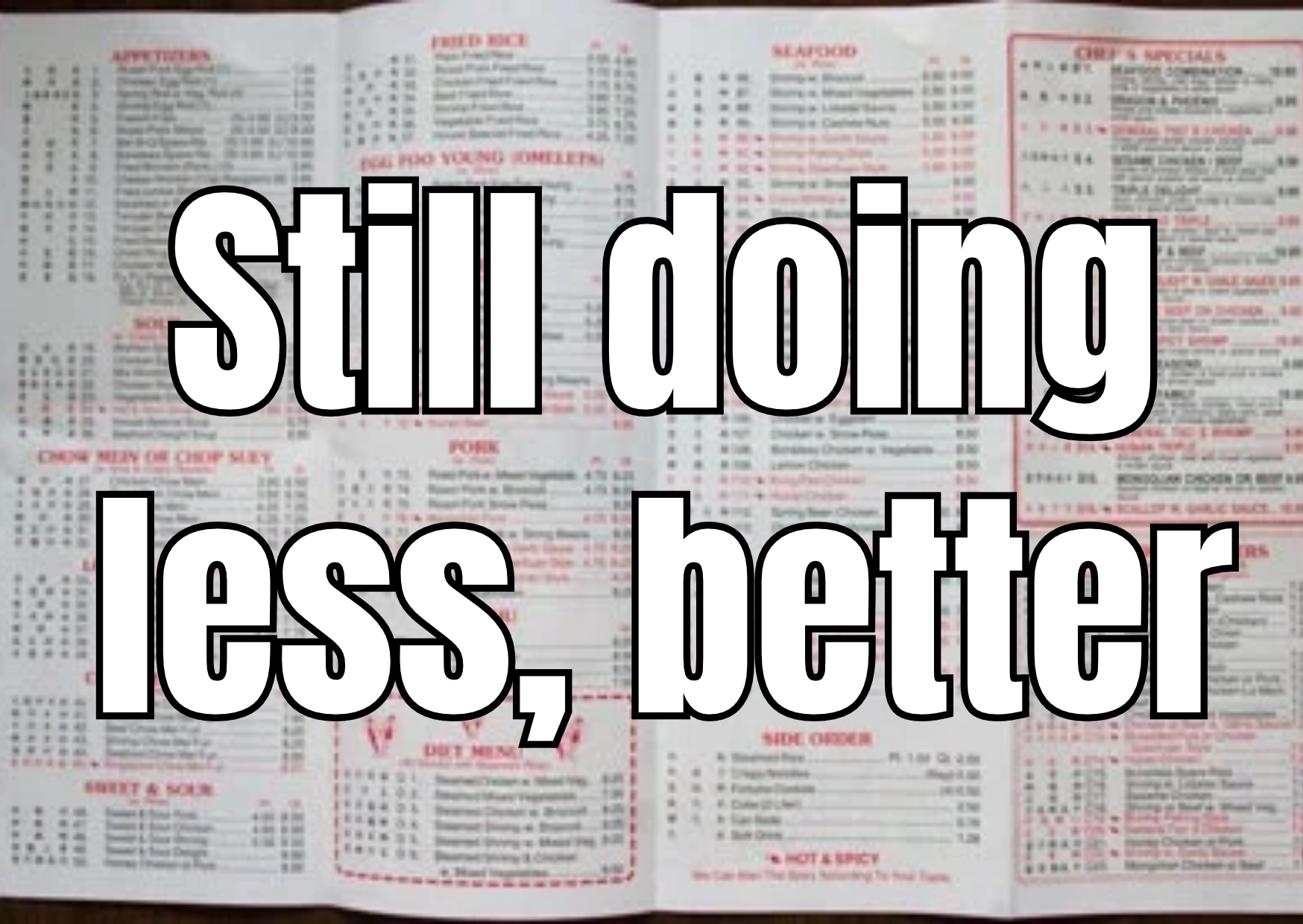
Have you ever noticed how Chinese takeout menus are nearly impossible to read?
The one in my desk drawer lists 119 regular items, 16 chef’s specials, 23 combination platters, and 6 diet menu items. On one side. Flip it over and there’s 56 lunch specials, 10 little plates of food, a map, a phone number, and two dragons.
It took me half my lunch hour to find chicken fried rice (back page, fourth column, 27 items down).
By listing everything, it listed nothing.
That’s how I opened one of my very first blog posts, Do Less Better, 13 years ago. It had six tips for how community college marketers could do better work by doing fewer things.
I was cleaning out my office drawer the other day and found the original menu all scrunched up stuck in the waaay back. Now I’m reaching for it again, because it still makes the point better than anything I’ve come up with since.
Back in 2013 I was a marketing army of one, in my eighth year as the marketing guy. I’d barely started running our Facebook page. I was in the middle of my second website redesign. I had a lot more learning to do.
Fast forward 13 years. There have been more stumbles, failed projects, and mistakes than I care to admit. And yes, I’ve had my fair share of successes and home runs, too.
And you know what? The post holds up pretty well. Honestly, I’m a little surprised 2013 me was that savvy.
At the risk of sounding like an old timer (I mean, if the shoe fits), the more things change, the more they stay the same.
The menu analogy still works
That same Chinese restaurant is still open. And while their paper menu has mostly given way to their mobile menu, they still list 56 lunch specials. And my focus is still being intentional about protecting the quality of my (and my team’s) work.
Quality beats quantity.
What matters isn’t the amount of work you do. It’s the impression the work makes.
What’s changed
I have a team now. We’re still lean and mean, but I talk about the work differently.
Astute readers know I talk a lot about owning the marketing function. Fill the space. The moment we cede it to someone else, it’s almost guaranteed not to come back to us without a significant struggle. That’s just as true today as it was 13 years ago.
When I reread the 2013 blog tips, I can now see that thread running through them. Every tip was about agency: what you control, what you decide, and what you refuse to surrender to the next loud person who barrels through your door.
Some tips aged better than others. For funzies, here are all six, then and now.
Six tips, revisited
1. Pick the low-hanging fruit.
Then: Make a list and start with whatever has the most impact for the least resources. When you’re an army of one, effort versus payoff is the whole game. You don’t have the bandwidth for anything else.
Now: That’s still somewhat true. But low-hanging fruit only helps if you know what counts as a win. If you don’t decide what you’re optimizing for, something else will decide for you. That decision is yours to make, and it’s one of the most important things a marketing leader controls. Choose the tree first. Then pick the fruit.
2. One and done.
Then: Make one annual media buy, so the sales reps stop knocking and knee-jerk decisions mostly go away.
Now: The way we buy media has changed, so the literal advice matters a lot less. The principle doesn’t. Invest real time building your annual marketing plan and calendar, and map out the year before it starts. That is the framework everything hangs on. When a new request shows up mid-year, you’re not deciding from scratch. You’re deciding whether it fits the plan. Front-loading the time pays off with faster, simpler decisions later.
3. Build the door and rip the knob off.
Then: Templates for everything: print, outdoor, fliers, scripts.
Now: We still use templates. But I’ve since learned that you need to also template how the work moves, not just how it looks. That means you need to develop systems, tools, and frameworks: intake forms, creative briefs, project workflows. They’re templates but at a higher operational level. Systems should reduce thinking, not require more of it.
Fun fact: staring at a blank page has yet to get easier.
4. Go for the long haul.
Then: Put publications on a print schedule, print everything at once, and don’t date anything so it lasts longer.
Now: We all rely less on print. And digital printing makes short runs easy, so most of that advice has aged out. The long haul now is about the big, resource-intensive projects. So when you build your next website, assume it’ll be around waay longer than anyone plans, and build accordingly. When you do video, gang-run shoots and capture more than one project needs. Build the content and assets once, then multi-purpose across media and iterate from there. Every hour you put into a big video project should pay you back 3x, 5x, 10x.
5. Just say “no.”
Then: If a request doesn’t fit your priorities, say so. Share your reasoning with your boss so they can back you up.
Now: 2013 me was a little snarky about this one. A flat no puts you on the defensive and keeps you an order taker who happens to decline orders. The leader move is to change the question. “What do you want us to make?” becomes “What are we trying to accomplish?” Sometimes the answer is still no. Sometimes it turns into a better yes. Either way, the goal is to say no to the wrong things so you can say yes to the right things.
6. Do good work.
Then: If your work is good, it’ll have a shelf life of its own.
Now: Still true. But good work deserves a follow-up. Before the work starts, decide what signal you’ll track to tell you whether it worked. You don’t need a massive dashboard. Pick one simple signal and give it three looks: now, before, and the pattern. That’s how you know what to keep doing, and how you do better next time. (More on that in [Simple Signals Beat Thorough Dashboards].)
Do the right work
If you like what I had to say here, you’ll probably like my next free webinar on October 30 at 2 p.m. Central: Do the Right Work to Do the Work Right.
We’ll cover how to use a simple intake process to prioritize requests and vet projects, so whatever you take on is set up for you to do your best work. Then we’ll cover how to measure the signal so you know how things performed and can iterate to improve.
Now if you’ll excuse me, I never did get those egg rolls.
